Homework 3
Your answers are due to be handed in by 5 pm on Wednesday, February 10 th.
1) A damped simple harmonic oscillator with a natural frequency ω0 = 10π radians/sec and a Q of 100 is sitting at rest at equilibrium. At t=0 a driving force is started resulting in a driving acceleration of sin(11πt).
a) Find the complementary function for this system including two as yet unknown constants.
b) Find the complete particular integral for this system.
c) Use the initial conditions to find the specific values for the unknown constants and thus the complete solution.
d) Sketch the resulting solution (or use software to help to plot it accurately).
e) Discuss the early behaviour (first hundred or so oscillations) and especially explain the low frequency beats observed.
2) The balance wheel of a clockwork watch oscillates with angular amplitude π radians
and period 0.500 seconds.
a) Find the maximum angular speed of the wheel.
b) Find the angular speed at the moment when the wheel is displaced only
π/2 radians.
c) Find the magnitude of the angular acceleration when the the wheel is displaced π/4 radians.
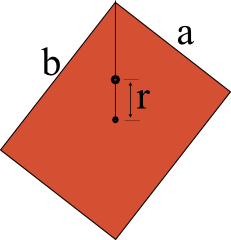
3) A rectangular block of wood with sides a = 35 cm and b = 45 cm is suspended on a frictionless pin through a small hole through the block and set swinging as a pendulum (see figure). The angle of swing will be kept small enough that the motion can be treated as simple harmonic. The small hole is a distance r from the centre of the face of the block along a line joinng the centre to one corner (see figure).
a) Plot the period of oscillation of the block as a function of the distance r. Choose your scales to make it clear that the curve has a minimum and show where the minimum is found.
Extra Credit! There is actually a line of points around the block's centre for which the swing period has its minimum value. What is the shape of that line? |
 |
4) A 1 tonne (103 kg) car carrying four passengers with a total mass of 290 kg travels over a ridged dirt road where uneven wear has produced regularly spaced ridges and valleys such that successive ridges are 4 m apart. The car jounces with maximum amplitude when it is driven over the road at 31.5 mph. How much will the car rise on its springs when the four people get out of the car at the end of the journey.
5) Three 10,000 kg ore cars are held at rest on a 30 degree slope by a cable attached to the top car. The combined force of the three cars elastically stretches the cable by 15 cm. At time t=0 the coupling between the upper two cars and lowest breaks and the car rolls away. Assuming that the cable obeys Hooke's law:-
a) find the frequency of the resulting oscillations of the remaining two cars and
b) find the amplitude of the oscillations.
6) As a little more practice in uncertainty calculations please compute the following assuming that all errors are independent and random.
a) (5 ± 1) + (8 ± 2) - (10 ± 4)
b)
(5 ± 1) × (8 ± 2)
c) (10 ± 1) / (20 ± 2)
d) (30 ± 1) × (50 ± 1) / (5.0 ± 0.1)
7) a) In order to measure the velocity of a cart on a horizontal air track, a student measures the distance d= 5.10
± 0.01 m that the cart travels and the time taken t = 6.02
± 0.02 s. Calculate her result for v = d/t with its uncertainty.
b) If the cart has a mass m = 0.711
± 0.002 kg, what is the correct value (with uncertainty) for the cart's momentum, p = mv=md/t?
8) Consider the following experiment. Two essentially identical eggs are taken. One is hard boiled and the other is left raw. The two eggs are attached to identical pieces of thread with hot glue (not enough heat there to damage the raw egg) and made into pendula. The two apparently identical pendula (apart from the slight dulling of the shell that accompanies hard boiling) are set in motion with the same amplitude. Time passes and it is seen that the raw egg pendulum comes to rest significantly faster than the boiled egg pendulum.
Please try to explain why the cooking state would matter. What could be causing the raw egg to slow faster than the cooked?
9) Consider an air track with two identical carts of mass m connected to each other and to the ends of the air track by identical springs of spring constant k. Show that there are two possible solutions for which both masses execute simple harmonic motion at the same frequency. What are the two frequencies at which this is possible?
Hint: this should look a lot like an example that we did in class!