|
|
1) In Young’s double-slit experiment slit #2 (bottom slit) is covered with a thin piece of glass. This slows down the light going to slit #2 and changes the relative phases of the light going to the slits. a) Assume that the glass is thick enough to retard the phase of the light going to slit #2 by p (180 degrees). What happens to the interference pattern? b) Assume that the glass is thick enough to retard the phase of the light going to slit #2 by p/2 (90 degrees). What happens to the interference pattern?
2) Briefly explain how Huygen sources make up a plane wave. (Diagrams!)
3) Why is there no interference pattern from the headlights of a distant car.
4) If one slit is covered in a two slit interference experiment, by what factor does the intensity at the center of the screen change?
5) What wavelength of visible light (450 nm < l < 700 nm) is reflected off a thin film that is 250 nm thick?
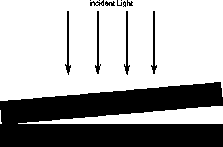
6) Red light (l=630 nm) illuminates the two glass plates shown below (figure in problem 10) from the top. On the right side the plates are separated by 5 mm. How many bright red fringes are seen from above the plates?
7) HRW 35.34.
In the double-slit experiment of Fig. 35-10, the viewing screen is at distance D = 4.00m, point P lies at a distance y = 20.5cm from the centre of the pattern, the slit separation d is 4.50μm, and the wavelength λ is 580 nm.
a) Determine where point P is in the interference pattern by giving the maximum or minimum on which it lies, or between which it lies.
b) What is the ratio of the intensity IP at point P to the intensity Icen at the centre of the pattern?
c) Plot the intensity of the light seen on the screen as a function of y from y = 0 to y = 30 cm.
8) What would happen to the pattern if a complete Young’s double-slit experiment were immersed in water having an index of refraction of n = 1.3?
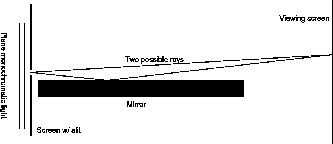
9) Lloyd’s mirror is an alternative arrangement for demonstrating two source interference. The apparatus consists of a single slit, illuminated by plane mono-chromatic light, placed close to a mirror. Consider carefully the paths of two light rays (eg. those in the figure) and thus describe in detail the intensity of the light seen on a distant screen placed perpendicular to the mirror.
|
|
10) HRW problem 35.74.
A broad beam of monochromatic light is directed perpendicularly through two galss plates that are held together at one end to create a wedge of between them. An observer looking down on the pattern reflected from the wedge of air (which acts as a thin film) sees 4001 dark fringes along the length of the wedge. When the air between the plates is evacuated, only 4000 dark fringes are seen. Calculate, to 6 significant figures, the refractive index of air from these data.
|
|