
A stretched string with linear density μ kg/m is held under a tension T Newtons. If the string is disturbed then the disturbance will travel as a wave along the string in both directions under the influence of the tension force. If we write the displacement from equilibrium at some point x along the string and at some time t as y(x,t), then this displacement obeys the Wave Equation with velocity
The wave equation is a second order linear partial differential equation
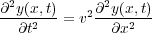
where v is the speed with which a disturbance travels along the medium. Its solutions are waves travelling in both directions (positive x and negative x) all with the same speed v.
Since the wave equation is linear any sum of such solutions is also a solution of the wave equation.
If the wave shape is a sinusoid such as sin(kx - ωt), then the Wavenumber k and the angular frequency ω must be related by

Wave Parameters
The natural description of a sinusoidal wave is parametrised by the wavelength, λ, the distance between successive peaks or successive zero crossings, and the frequency f = 1/Period, where the period is the time between successive peaks or troughs.
These parameters are related to the wave speed through

The position function for such a sinsoidal wave can be written either
sin( ± 2πft) or sin(kx±ωt)
so that the wavelength λ = 2π/k and the angular frequency ω = 2πf.
The wavenumber, k=2π/λ, and the angular frequency, ω, are then related to the wave speed by v = ω/k.
Standing waves
A standing wave is a solution of the wave equation in which the disturbance appears to stay in one place and the parts of the string simply oscillate from side to side with different amplitudes but a single frequency. As such a standing wave is a Normal Mode for the system.
For a string or wave tray whose ends are fixed (y(0,t) = 0 and y(L,t) = 0) such standing waves have the form

where k = 2π/λ = nπ/L, ω = kv = nπv/L.
Such a solution can always be written as the sum of a wave travelling from left to right and a wave travelling from right to left. Travelling waves are the natural description when the disturbance is small compared to the length of the medium. Standing waves are the natural description when the disturbance fills, or nearly fills, the medium.
The general solution of the wave equation is

where f and g are arbitrary functions specifying the shapes of the waves travelling from left to right (f) and from right to left (g). Thus any function of the form f(x±vt) is a solution of the wave equation.