
Basic Facts Weeks 6
General Waves on a String
The general motion of a string with its ends fixed is given by a sum over all of the normal modes. On a string of length L with wave speed v we have
where the An and Bn are constants determined by the initial conditions. In particular, the Anare determined by the shape of the string at some time, usually t = 0, while the Bn are determined by the velocity of each point on the string at t = 0.
This is another example of the general principle that the most general motion of a system is a linear sum (a mixture) of its normal modes.
Fourier Analysis
The idea that a periodic function, or simply a function on a finite domain, can be decomposed into a sum of sines and cosines with that period is called Fourier Analysis (after Jean Baptiste Joseph Fourier 1768-1830). It is an example of the decomposition of a function into a complete set of orthogonal functions. Fourier also showed how to compute the coefficients (Anand Bn above) for any such function.
Plucked Strings
A plucked string can be treated as starting from rest (Bn = 0) with an initial saw-tooth shape. The resulting set of normal modes, also called the Spectrum since it dictates the vibration frequencies, will have the following properties.
a) Generally decrease in amplitude as n increases.
b) Be missing any modes which have a node at the plucking point.
c) Emphasise any modes that have an anti-node at the plucking point.
Thus a string plucked at its center will vibrate only in modes 1,3,5,7,9,etc., a string plucked at L∕3 will vibrate only in modes 1,2,4,5,7,8,10,etc.
Useful Facts
General Solution of 1-D Wave Equation
The general solution can be written either as a sum of waves travelling from left to right and from right to left,in the form

or as a sum of standing waves. For the string with ends fixed at x = 0 and x = L that has the form

where the An and ϕm are constants that are determined by the way the wave was started.
Fourier Analysis
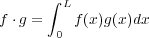
On the interval 0 - L the sine and cosine functions are orthogonal if we define the inner product (dot product) of two functions f(x) and g(x) to be
so that
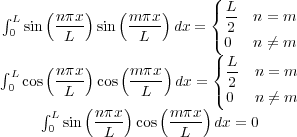
For a wave on a string with fixed ends cosine terms spatial terms are excluded and the coefficients An and Bn in the topmost equation can be found from

and
