NOTE: Many of the facts are true ONLY for the case when the charges creating the electric field are at rest or very nearly so.
The field from an infinitely long straight line of charge of density λ points radially outward, perpendicular to the wire. It takes the same value at all points along the wire and at all angles round the wire and it varies with distance ρ from wire as
E= λ
2πε0ρ
The potential varies as the log of the distance from the wire and so cannot be set to zero at infinity or at the origin.
Outside the charge distribution, any cylindrically symmetric charge produces the same field as if all the charge were in the form of a line of charge on the axis. Similarly, any spherically symmetric charge distribution produces the same field, outside the charge, as if all the charge were in a point at the center of the sphere.
The field from an infinite flat sheet of charge of density σ points
away from the sheet and has magnitude
E = σ independent of the distance from the sheet.
2ε0
The electric field E very near the surface of a conductor is perpendicular
to the surface and causes (or is caused by) a local charge density σ where
E = σ .
ε0
The work required to move a charge q from r1 to r2 = q(V(r2) - V(r1)).
If a particle of charge q moves freely from r1 to r2 then its K.E. changes by q(V(r1) - V(r2))
Two conductors with charges +Q and -Q form a Capacitor. There is a
potential V between the conductors and the potential is proportional to the
charge. We define the Capacitance by the equation
Q = CV so that C=Q/V.
The value of the capacitance depends only on the geometry of the conductors.
For a pair of parallel plates of area A with separation d,
C=ε0A
d
where d is very small compared to the size of the plates.
The field between the plates of such a parallel plate capacitor is uniform
and has strength
E = σ
ε0
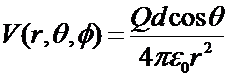
The electrostatic potential V a distance r>>d from a dipole made from
charges Q separated by d is givenin spherical polars by
The field from an infinite straight line of charge with density λ
Coulombs/metre depends only on the perpendicular distance ρ from the line
has magnitude
E = __λ____
2πε0 |ρ|
and points perpendicularly outwards (or inwards) from the line.
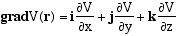
In a region where the electric potential V(r) is known, we can calculate the electric field E(r) using the relation

where grad V(r) is given by
 .
.