Waves in 3-D
A 3-D wave is a generalisation of a 1-D wave that travels throughout a region of 3-D space. Examples include sound waves (longitudinal pressure waves travelling throught the medium of air) and light (transverse waves in the electro-magnetic field, these travel at 3×10⁸m/s in the absence of any medium and slower by a factor of the refactive index through transparent materials).
Plane waves are described by a wave function of the form f=F0exp(i(k·r-ωt) where wave vector k points in the direction of travel and has magnitude k=2π/λ.
Spherical waves are described by a wave function of the form f=F0exp(i(kr-ωt) /r, where again k=2π/λ. The amplitude of a spherical wave must decrease as 1/r in order to keep the total energy flowing in the spherical wave constant as the wave spreads out.
The Intensity of a wave is a measure of the energy crossing unit surface area per second and has the units of Watts/m2. The intensity of a wave is proportional to the square of its wave function.
James Clerk Maxwell showed that a mathematical implication of the four laws of electromagnetism, Gauss for the electric field, Gauss for the magnetic field, Faraday, and Ampere-Maxell, was that electric and magnetic fields should obey a wave equation. In the absence of any material the waves should travel with the speed of light. With a material present the speed would be reduced by dielectric and magnetic polarization effects. The new speed (v) is related to the vacuum speed (c) by
v = c/n
where n is called the refractive index.
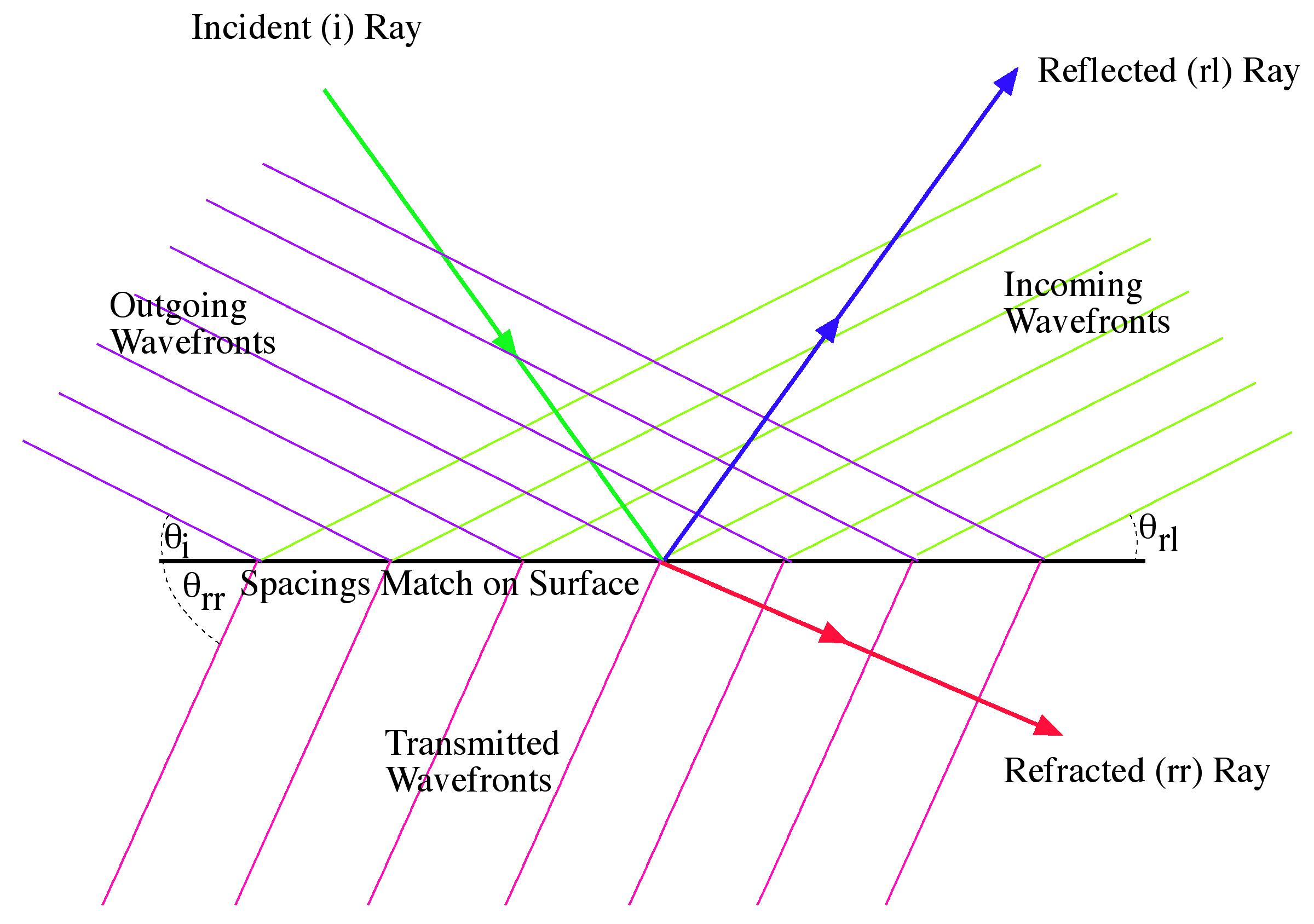
When light falls on a planar interface between two materials a portion of the light is reflected and a portion transmitted but in a new direction. We say that the transmitted light has been refracted. By considering the pattern of wavefronts on the planar surface we can show (figure below) that the incident, reflected, and transmitted rays all lie in the same plane. The reflected light leaves the surface at the same angle that the incident light hit it (
θi=θrf while the refrected light leaves a different angle given by Snell's law
n1sin(θi)=n2sin(θrr).
Christian Huygen's showed that while light propagated through empty space in straight lines we could explain the curious details of shadows and the patterns formed by light passing through narrow slits if each point on a travelling wavefront acted a source of outgoing spherical waves. Their sum at any point then gave the wavefunction at that point. This provides a geometrical explanation of interference and diffraction phenomena.
Interference refers to any phenomenon which occurs as superposition of two or more coherent waves add and subtract to form a new pattern of intensities.
Diffraction is a similar term but usually refers to those effects of interference that result in bending of the paths of the waves. Examples include the spreading of waves from a single slit as well the "diffraction patterns" resulting from waves travelling through more complex sets of obstacles.
Coherence is the probperty of waves having a fixed phase relationship one with another. Depending on the problem the coherence may need to be from one time to another (temporal coherence) or from one place to another (spatial coherence). Coherence is only possible between waves of the same frequency/wavelength (monochromatic waves) though polychromatic waves can exhibit coherene for individual colors. The best source of coherent light is a laser.
Young's Slits
Monochromatic plane waves falling onto a pair of slits of negligible width give rise to a "diffraction pattern" consisting of a series of equally spaced bars spread perpendicularly to the direction of the slits.
Constructive interference, and thus maximum resulting intensity, occurrs when the length difference between the paths from the two slits, d sinθ = nλ for some integer n.
The actual intensity of a two-slit diffraction pattern is given by I∝(1+cos(k×d×sinθ))2.