Engineering and Hamilton
Some thoughts on your academic plans
The most frequently attended affiliated engineering school for those going on from Hamilton has been Columbia's Fu Foundation School of Engineering and Applied Science. Below, you'll find in italics a summary of their requirements; you can also find them at https://undergrad.admissions.columbia.edu/apply/combinedplan ). For the most complete and accurate information, it is a good idea to go to the Columbia website. On the page you reach with this link, search for "Pre-Combined Plan Curriculum Guide".
A summary of admissions requirements from the Columbia website is instructive:
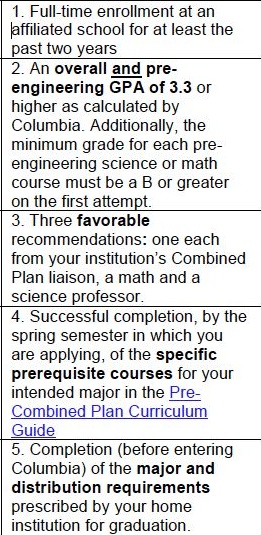
You can download a pdf file showing the relationship between Hamilton courses and the ones prescribed by Columbia.
The following lists the basic required classes for guaranteed admission. Please see your Combined Plan liaison for specifics.
- Mathematics (4 terms); (Ordinary Differential Equations often required -- see individual programs)
- Physics (2 terms) plus lab; Modern Physics (not required for all majors)
- Chemistry (1 term -- but see individual programs; some require a second term) plus lab
- Computer Science (1 term programming in JAVA, C++, Python, or MATLAB)
- Economics (1 term)
- English Composition (1 term)
Although the above courses are required for guaranteed admission, an applicant who has not met the requirements is still considered for admission, at the discretion of the Combined Plan admissions committee.
When choosing the 3-2 sequence, note that all of Hamilton's requirements have to be satisfied before the student leaves at the end of the junior year.
- In particular a student must complete our Writing Program and must be making good progress toward the completion of a Hamilton concentration. The majority of students who've gone to engineering studies have been physics majors. In the case of physics majors, we accept for completion of the Hamilton physics requirements their engineering work at Columbia, but they must have completed key junior courses here.
- A physics major who will leave for engineering studies in one of our affiliated 3-2 programs (Columbia, R.P.I., Washington University in St. Louis) must have completed the following physics courses: 190, 195, 290, 295, 245, 350, 370, and 390.
How to start your program (sample schedules)
- The student will be studying science and math in the first year at Hamilton beginning with the fall term.
- Since the most popular track to engineering school has been in physics, the science choice should be Physics 190. The required term of chemistry can be taken after the first year. However, if the student is interested in chemical engineering or another specialty that is chemistry-rich, then the chemistry course that has been recommended for the student by the chemistry department should be taken in the first term and the physics should be taken starting in the following fall.
- The math department will make a recommendation as to where in the math curriculum the student should begin. That course should be taken in the first term.
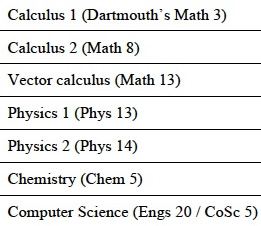
Prerequisites for the Dartmouth 2-1-1-1 Program
The Dartmouth program currently lists the following courses (their course numbers) as prerequisites. Thus, they should be completed in the first two years at Hamilton.
General remarks
We want to make sure the student has a viable, interesting plan of study that will leave him or her with a sound education should the engineering option fall by the wayside (it is common for students to change their career goals as they progress through college). Assuming that a student who is willing to commit to becoming an engineer has strong interests in technology/science/math, a curriculum at Hamilton that is rich (but not monotone) in those subjects should be suitable.
Students opting for 4-2 (means applying to Columbia to do undergraduate work in engineering after having finished a normal 4 year program at Hamilton) will have an easier time of organizing their Hamilton course work because of the extra time available to complete required courses.
In general financial aid has been strong for those going on in engineering. However, our experience has been that, although Hamilton may provide them with excellent support, students who are neither permanent residents nor citizens of the U.S. or Canada are not guaranteed good financial packages at the coordinate engineering schools. Without generous financial aid these schools may be unaffordable.
Engineering Advisors: Professor Gordon Jones, and Professor Ann Silversmith, Department of Physics.
updated July 2015