Homework #1
First we shall have a few questions. These require short (2 or 3 sentence) written answers explaining your reasoning. Simply giving the answer will earn very little credit. Almost all the credit goes to the explanation.
1Q6) Discuss how the notion of symmetry could be used to estimate the number of marbles in a 1-litre jar.
1Q9) A recipe for a soufflé specifies that the measured ingredients must be "exact" or the soufflé will not rise. The recipe calls for 6 large eggs. According to the USDA, the volume of "large" eggs can vary by ±10%. What does that tell you about how careful you must be with the other ingredients?
2Q5) If one object has a greater speed than a second object, does the first necessarily have a greater acceleration? Explain, using examples.
2Q15) You travel from point A to point B in a car moving at a constant speed
of 70km/hr (you are in Canada!). Then you travel the same distance from point
B to point C, moving at a constant speed of 90km/hr. Is your average speed
for the trip 80km/hr? Explain why or why not.
NOTE Since this is a chapter on 1-D kinematics, you may assume that a single
straight line can be drawn through all three points.
Then we shall usually have about a dozen problems. Since this is a short week I
have cut it down to eight.
These normally require mathematical
answers with enough words added to explain the reasoning. Again, only a small
part of the credit is awarded for the correct answer, most of it goes to the
working and the explanation of the working. This is especially true of the odd
numbered problems which have answers given in the back of the book. To save
you trouble I have put the answers in the brackets at the end of these problems.
In these cases no credit attaches to the answer; it is all
for the working.
You should notice that the book marks the approximate difficulty of its problems.
I tend not to set type I problems. These are excellent problems for you to try
as you are doing your reading. The answers to all the odd ones are given and
so you can tell if you are understanding the material. The type III problems
typically require you to combine several different ideas to approach a single
problem and I will occasionally set one or two of these to challenge the more
capable students.
1P38) One hectare is defined as 104m2. One acre is 4x104 ft2. How many acres are there in one hectare?
1P40) Estimate the number of gallons of gasoline consumed
by the total of all automobile drivers in the US in one year.
NOTE that this does not include truck drivers (anyway, they use diesel!)
2P8) According to a rule-of-thumb, the distance in miles from a lightning strike
to the person hearing the thunder can be found by measuring the time between
seeing the flash and hearing the thunder and then dividing by five. Assuming
that the flash of light arrives in no time at all, estimate the speed of sound
in m/s.
NOTE You have to be careful with the units. Use the tables in the front of the
book to help with the conversions.
2P11) Two locomotives approach each other on parallel tracks. Each has a speed of 95 km/hr with respect to the ground. If they are initially 8.5 km apart, how long will it take them to meet? (160s to 2s.f.)
2P18) At highway speeds, a particular automobile can accelerate at about 1.6m/s2. At this rate, how long would it take to accelerate from 80 km/hr to 110 km/hr?
2P19) A sports car moving at constant speed travels 110m in 5.0 s. If it then brakes and comes to a stop in 4.0 s, what is its acceleration in m/s2? Express the answer in terms of "g's", where 1.00 g = 9.80 m/s2. (-5.5 m/s2, -0.56 g)
2P23) A light plane must reach a speed of 33 m/s for takeoff. How long a runway is needed if the (constant) acceleration is 3.0 m/s2? (180 m to 2 s.f.)
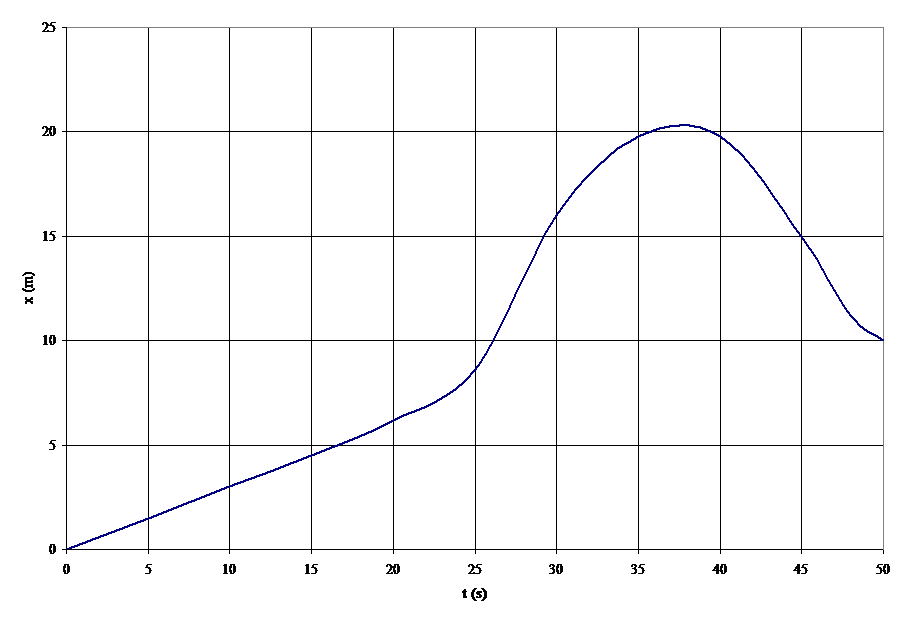
2P51) In the figure below, (a) during what time periods, if any, is the velocity
constant? (b) At what time is the velocity greatest? (c) At what time, if
any, is the velocity 0? (d) Does the object move in one direction or in both
directions during the time shown?